
银翼杀手
C919 completes first scheduled international commercial service_我的网站

A | IT时报记者 郝俊慧 “市面上会聊天的AI很多,能把结果直接交付出来的不多。

B | ”7月17日,上海世博展览馆,当工作人员和记者说这句话时,身后大屏上灵犀正在自动拆解一份销售数据,生成带公式的Excel和可编辑的PPT,全程没有人碰过键盘。
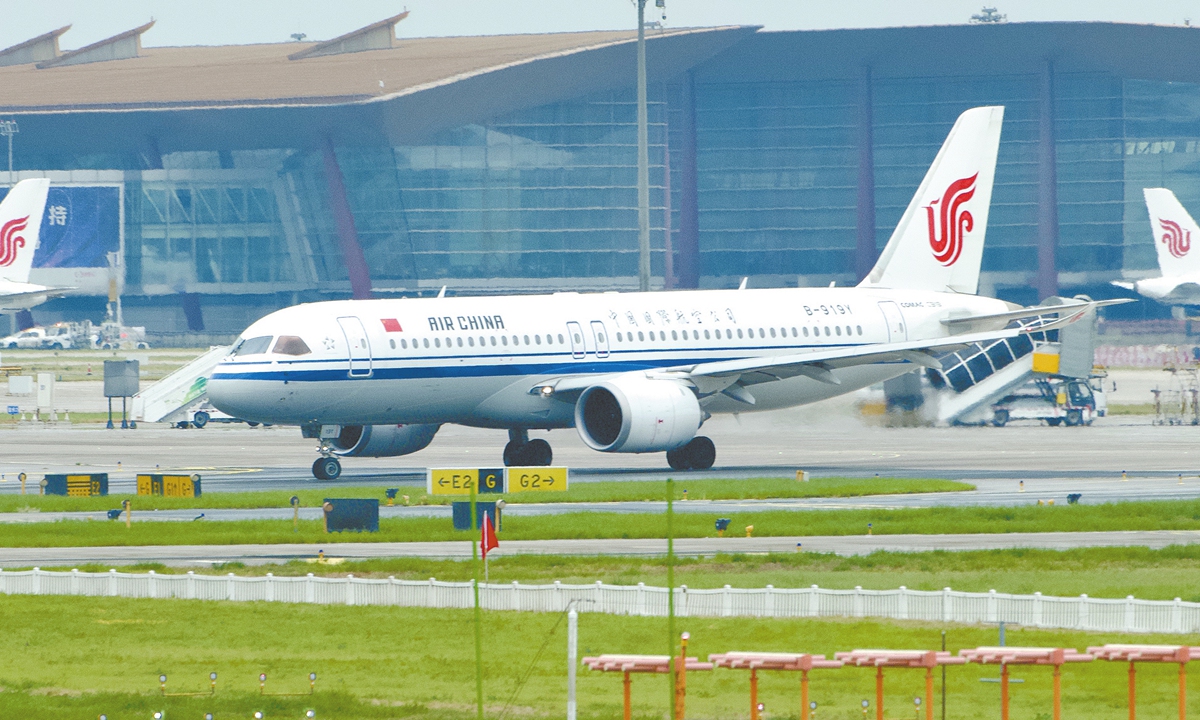
As the C919 climbs higher and flies farther beyond China's borders, the runway behind it gradually disappears. What comes into focus instead is a much broader journey - one in which China's advanced engineering capabilities are reaching new markets, new partners and new possibilities around the world.
Historic moment
Hours before takeoff, a passenger surnamed Zhang, who was completing check-in procedures at Beijing Capital International Airport, said with a smile that he had stumbled into a "historic moment" by chance.
"I didn't pay much attention when I booked the ticket. I had heard that our homegrown C919 would soon begin international service, but I never expected it would be this very flight," Zhang told the Global Times on Wednesday. "I feel incredibly proud and excited."
From its maiden flight in Shanghai in 2017, when its first takeoff had many watching with bated breath, to its first scheduled international commercial service today, the C919's journey reflects China's sustained push to build up its capabilities in advanced aviation manufacturing.
In recent years, China's top-level policies have strongly supported the development of high-end manufacturing. As the nation enters the opening year of the 15th Five-Year Plan period (2026-30), Chinese high-end manufacturing is increasingly translating technological breakthroughs into globally competitive products and solutions to contribute more broadly to industrial development and connectivity worldwide, Chinese experts noted.
And the C919 program is one of China's most ambitious endeavors to push the frontiers of high-end manufacturing.
The C919 is China's first self-developed trunk jetliner in accordance with international airworthiness standards and registered with independent intellectual property rights, according to the Xinhua News Agency on Wednesday.
Industry experts said the C919's progress reflects the rapid advance of China's broader manufacturing capabilities. Only a handful of countries are capable of developing single-aisle mainline passenger jets, and even fewer can bring a certified aircraft into commercial service.
The C919 aircraft's biggest achievement is that China has built the capability to take a large passenger jet from the drawing board all the way to a certified commercial product, covering overall design, airframe manufacturing, system integration and airworthiness approval, Wang Ya'nan, editor-in-chief of Beijing-based Aerospace Knowledge magazine, told the Global Times on Wednesday.
Much of the aircraft's design, major structural manufacturing and key systems are completed in China. He said this marks a significant step forward in China's civil aviation manufacturing capability, placing the country among the few able to develop a modern trunk-line jet and bring it into commercial service. Its expanding operations now represent the next stage of that progress, he added.
As of Monday, the C919 aircraft had served 57 routes linking 25 cities and handled more than 7.5 million passenger trips, said the Commercial Aircraft Corporation of China (Comac), the jet developer, according to Xinhua.
However, the C919 still faces intense competition in a global market dominated by established players. Experts said, however, that its competitiveness could continue to strengthen as operational experience grows and China accelerates indigenous development of key components and systems.
The UK-based aviation industry publication Airline Economics noted on July 13 that Malaysia Airlines continues to consider Comac's C919 as a future fleet option, but Western regulatory certification remains a key requirement before the carrier would consider operating the Chinese narrowbody.
This has also brought into sharper focus the dual considerations of certification and market demand among potential international customers for the C919, as Wang said this is precisely why the C919's continued expansion into new routes and markets matters.
As cross-border services expand, the C919 will also need to move closer to international operating standards by building a support network that goes beyond its domestic maintenance system to cover the full cycle of international operations, including regulatory coordination, overseas maintenance facilities and spare-parts logistics, Han Tao, an expert with China's civil aviation think tank, told the Global Times on Wednesday.
Strengthening these capabilities will be crucial to supporting more international routes and meeting the standards and operational needs of potential overseas customers, Han said.
Meanwhile, industry observers noted that China is also stepping up efforts to advance key components and systems for large commercial aircraft, an area that remains a major challenge for most countries' aviation industries, with mature capabilities still largely concentrated in the US, the UK and France.
Pushing boundaries, sharing opportunities
As the C919 flies farther, it is carrying with it not only China's advances in high-end manufacturing, but a broader story of how Chinese innovation is moving from breakthroughs at home to new possibilities shared with the world.
Underpinning that shift is China's expanding advanced manufacturing capacity and increasingly complete industrial ecosystem, which are helping turn technological breakthroughs into scalable products, a Chinese expert said.
China is upgrading its traditional industrial base while cultivating new sectors that could shape future competitiveness, seeking to move beyond scale and cost advantages toward a more innovation-driven industrial model, injecting new impetus into the country's high-quality development, according to Xinhua's another report on July 21.
The nation's 15th Five-Year Plan underscores the development of a modernized industrial system with advanced manufacturing as its backbone, the report said.
China's vast and diverse market provides advanced manufacturing with something equally important as technological capability: abundant real-world scenarios for testing, refinement and commercialization, Bian Yongzu, executive deputy editor-in-chief of Modernization of Management magazine.
This helps turn breakthroughs into mature, scalable products more quickly. Over the longer term, he said, advanced manufacturing will strengthen China's competitiveness by combining stronger industrial capabilities with complete supply chains and global cooperation, allowing more Chinese technologies, products and solutions to reach international markets, Bian said.
Aviation manufacturing, as a key pillar of high-end manufacturing, is benefiting from this broader push toward industrial upgrading and technological innovation.
At the fourth China International Supply Chain Expo held in Beijing in June, a complete aviation industry innovation chain stands out, spanning aviation materials, core forgings and low-altitude economy applications, drawing widespread attention to the participating companies, Xinhua reported.
Bian said that a complex project such as the C919 can drive coordinated upgrades across advanced materials, precision equipment, core components, system integration, logistics and skilled talent. In this sense, building a large commercial aircraft is a comprehensive test of a country's industrial depth, supply-chain coordination, and ability to turn sophisticated technologies into reliable commercial products.
。 一年前,人工智能展会上比拼的还是模型能否写文章、生成PPT、回答问题;今年,WAIC 2026展台上最热的关键词变成了“智能体”。然而,许多产品团队都很清楚,真正决定产品竞争力的,是AI能否理解场景、调用工具,并最终交付可用成果。

C | 本届WAIC,金山办公以“AI办公效率合作伙伴”为主题,带来了刚刚在“2026 AI生产力大会”发布的两款智能体产品:面向个人用户的灵犀专业版,以及面向组织用户的全新组件WPS Comate。 其中,灵犀专业版为个人用户提供专属AI办公助理;WPS Comate则作为全新组件,推动WPS 365向组织级AI办公平台升级,帮助企业“长出大脑和手脚”。 AI重新定义办公软件 “办公软件正在进入第三个时代:从单机办公、协同办公,走向AI办公。AI重构的不是软件,而是工作完成的范式:过去是人操作软件,今天是人提出目标、AI参与完成。”金山办公CEO章庆元说出了此次新品发布的底层逻辑。 灵犀专业的能力分为三层:一是懂上下文,以项目为单位沉淀写作风格和数据偏好,越用越懂你;二是高质量交付,能调用文档、处理数据、打开浏览器、编写代码;三是Office专业操作,交付可编辑、可溯源的原生文件。 “我们不是在Office上加一个AI,而是让AI长出Office。

D | ”金山办公助理总裁田然表示,灵犀专业版的目标不是在Office上加一个AI,而是让AI长出Office,以AI为原点,重新定义办公软件的形态。

E | 田然强调,文档的本质是人的语言,是沟通的载体,在AI时代不仅不会消亡,反而会变得更加重要。因此,灵犀专业版深度调用WPS原生API,确保AI生成的内容能够真正进入办公流程,成为可编辑、可审阅、符合格式规范的文档、表格和演示文稿,而不是一张无法继续加工的“答案图片”。 首个将“企业大脑”交付落地 如果说灵犀专业版解决的是个人效率问题,那么WPS Comate瞄准的则是组织级AI应用。 穿过个人体验区,WAIC展台另一侧的WPS Comate演示区域吸引了更多企业用户驻足。 “企业不缺大模型,缺的是把模型能力融入业务流程、沉淀为组织能力的管理体系。”章庆元指出。

F | 这也是当前企业AI落地面临的核心挑战。

G | 通用大模型拥有广泛的世界知识,却不了解企业内部长期积累的业务文档、数据资产和流程经验。而这些沉淀在组织内部的知识,正是AI从“通用智能”走向“企业智能”的关键。 针对这一问题,金山办公副总裁王冬提出了组织级AI办公落地的“三二一”体系。 所谓“三通”,即通知识、通数据、通能力。企业需要打通分散在文档、业务系统和流程中的知识与数据,让AI真正理解业务;同时连接ERP、CRM、OA等系统,让AI从“回答问题”进一步升级为“执行任务”;“两管”,则是管成本、管安全,让企业能够清晰掌握AI投入,并确保数据和权限安全;“一平”,是以WPS Comate作为统一入口,将上述能力整合在一个组织级AI平台中,避免不同AI工具割裂运行,推动企业形成长期可复用的智能能力。 “模型是发动机,但决定这辆车能否真正跑起来的,是数据是否打通、系统是否连接、成本是否可控、权限是否可管。”章庆元说。 谁是真正的AI搭子? 钉钉月活2亿、飞书3000万、企微1亿……互联网时代,阿里、字节、微信抢掉了大部分协同办公的蛋糕,但AI换了一副牌。 所有人都想当你的“AI办公搭子”,然而,竞争远没有结束。 今年4月,德本咨询发布《2026行业级智能体TOP100》,WPS灵犀位列办公领域第一,超过飞书、钉钉等同类产品。 与此同时,金山办公基于自研表格基座Qingqiu Agent打造的WPS AI表格Agent,在国际权威基准SpreadsheetBench Full 912全量榜单中取得73.46%的成绩,位列全球第一,并首次超过该榜单设定的71.33%人类专家基线。今年7月11日,该产品又以98.25%的成绩登上Verified 400专家精标榜单第一名。 这些成绩背后,是围绕“AI如何真正进入工作流”的竞争。当每个人、每个组织都需要一个AI搭子时,真正的胜负手并不只是模型参数,而是谁能让AI更懂工作、更懂业务,也更接近真实的生产场景。
Current article:http://iu41ifj.foujiongwenruapoumeizhan.buzz/list_x7m36qj/soumc.html
Published on:00:06:22