Secession: Why some in Oregon want to become part of Idaho_我的网站
A |
Visitors watch humanoid robots of Unitree Robotics boxing at the World Intelligence Expo 2026 in Tianjin, North China, on May 30, 2026. The expo brings together over 700 exhibitors to showcase cutting-edge technologies, products and application scenarios in the field of artificial intelligence (AI). Photo: XinhuaDue to intense demand, the final online winning rate of Unitree Robotics' IPO - China's first humanoid robot A-share stock - is razor-thin 0.0181 percent, the company announced on Monday. In plain language: you needed to be one of the lucky 5,525 applicants to get shares. Unitree Robotics is heading to the STAR Market of the Shanghai Stock Exchange. The company set the offer price at 150.8 yuan ($22.35) per share, valuing the company at roughly 61 billion yuan on issuance. A total of 40.45 million shares are being offered, the company released its IPO subscription results on Monday, when the IPO subscription started, with payment due by August 12. Investors piled in so heavily that the preliminary online subscription multiple hit an eye-watering 8,288.82 times - far above the 100-times threshold that triggers the clawback mechanism, according to Unitree's announcement Before the clawback, more than 9.78 million accounts had submitted valid applications for a staggering 53.64 billion shares, producing a preliminary winning rate of just 0.012 percent - roughly one in 8,289. After the adjustment between offline and online tranches, the final online allocation was fixed at 9.707 million shares - about 30 percent of the post-strategic-placement total. According to a report released by the Smart Analytics Global (SAG) on Monday, Unitree's humanoid robot shipment accounted for 31 percent in the world in the first half of 2026, with shipments rising 170 percent year-on-year to approximately 5,900 units, ranking second after another Chinese robot vendor AGIBOT. Chinese humanoid robot manufacturers together accounted for 97 percent of global shipment in the first half of the year, remaining the center of the current humanoid robotics boom, SAG report showed. Global Times 。 Mike McCarter knows his American history almost as well as he knows his Bible. His family has lived and worshipped in Oregon for four generations. "The only time I lived out of the state was during the Vietnam War when I was in the military," he said.But his Oregon may not be the Oregon you're thinking of, the one with the misty rugged coastline, pinot noir wineries, and its loyally Blue politics. McCarter lives in the town of La Pine, in the state's rural and more sparsely populated part – the Red side of Oregon. "It's almost like the Grand Canyon goes right along the Cascade Range," he told correspondent Lee Cowan. "It is a big divide."What that means politically, he says, is that the Blue part of Western Oregon always outweighs the Eastern part's Red. "In talking to a legislator over in the Portland area, I said, 'The legislature doesn't listen to our people, our representatives over here.' He said, 'Whoa whoa whoa, stop, Mike. We hear what they're staying. We just out-vote you.'"
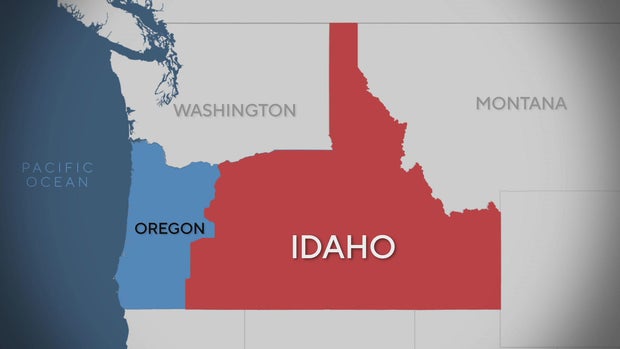
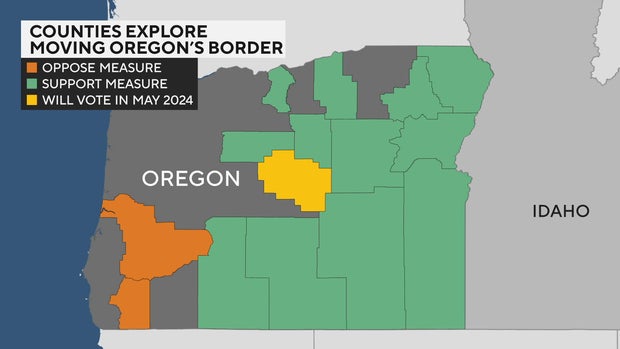
So, McCarter decided to look for greener pastures - or in this case, at least ones a little more red. Last fall, when "Sunday Morning" first met McCarter, he was spearheading a campaign called Move Oregon's Border. The group had been busy introducing ballot measures all across the state asking voters about the idea of pushing the urban, Blue bits of Oregon into a smaller but still populous state, and then taking the rural Red bits and creating what would be part of a more expansive Idaho.The group Move Oregon's border advocated for moving the border so that rural counties in Oregon's east would become part of Idaho, a more conservative state. CBS News Sandie Gilson owns a real estate business in rural John Day, Oregon, which is closer to Boise than it is Portland in virtually every way. She told Cowan, "When you have a government that won't listen to the opposition, or take into account those of us that live out here, then we have no government representation."Cowan asked Gilson, "Are you optimistic that you think you have a chance?""I look at it like the American Revolution was a big hurdle to make, and they did it," she replied.
It'd been a year since "Sunday Morning" visited, so Cowan went back, to find out how things stood. Back then, nine counties had voted in favor of considering making Eastern Oregon part of Idaho. Now, that number is up 12, with another set to vote next May. CBS News "We're getting into people's heads about this," McCarter said.As for Idaho, well, it's at least open to discussions. This past spring Idaho's state representatives approved a measure to begin a dialogue with Oregon over whether and how to redraw their common boundary. But so far, McCarter said Oregon is playing hard to get, at least in public. "We've heard from behind the scenes, 'Wait a minute, if we fund a bridge in Eastern Oregon, why would be we do that if it's going to become Idaho?'" he said. But the opposition has swung into gear, too. A Portland non-profit called Western States Center is branding the move a "radical change" that would raise taxes and cut wages. Comparing it to Oregon's past white nationalists hate groups, one ad declares, "Members of Patriot Group, a white nationalist hate group, support a secession. Makes you wonder: Why are violent extremists pushing for secession?"Their message: If rural conservatives don't like Oregon's urban liberal leanings, well, don't move the border, move themselves instead.
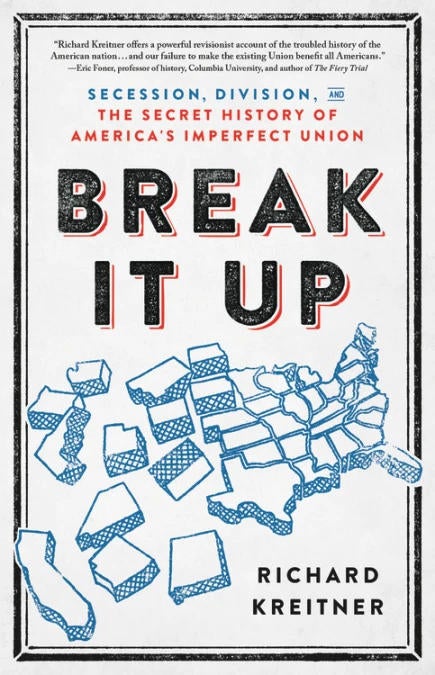
McCarter said, "We're not running away from the problem, we're not going to run away and move to Idaho. We're going to deal with the problem right here and now."There are a lot of details still to be ironed out, and the devil is in every one of them. Not to mention the fact that actually changing the border would require both Oregon and Idaho to agree, and would then need approval by the U.S. Congress.Richard Kreitner, author of the book "Break It Up: Secession, Division, and the Secret History of America's Imperfect Union," says it's hardly a new idea: "I don't think that we should act like state lines are written in stone. We should look at them and say, 'Does this actually make sense?' Little, Brown "Secession has always been there. Catholics lived in Maryland, debtors lived in Georgia, you know, Puritans lived in New England. They were kind of separate to begin with. And that's why they wanted nothing to do with one another.""So, it's really woven into our DNA?" asked Cowan. "Absolutely. There's nothing sacred about Oregon. There's nothing sacred about Delaware or my native New Jersey, in my opinion. You know, these are just kind of inherited forms."Mike McCarter will be the first to tell you that moving Oregon's border is radical. But, he says, if we've learned anything about our politics in the last several years, it's that "conventional" seems so yesterday.
"I mean, as fast as things are changing in this country right now, why can't we?" he said. "Why can't people still have the right to vote for who governs them?" For more info: